








Can a Car LED Display Screen Drain the Vehicle Battery?

During a recent factory visit, one of our European clients asked a very practical question:
“Could a car LED display screen actually drain the engine battery and make it impossible to start the car?”
It’s an excellent question — and the answer is yes, it can happen, but only if the screen is installed incorrectly. Let’s explore why this happens and how to prevent power drain from Car LED screens on vehicles.
Understanding Power Consumption of Car LED Displays
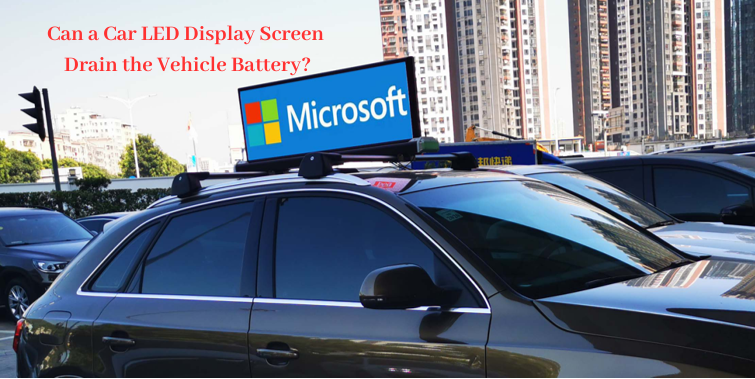
Every car LED display—whether it’s an LED advertising screen, a rear window message panel, or a roof-mounted LED display—draws electrical power from the car’s battery.
When the display is installed properly, it connects to the ACC (ignition) power line, meaning it only turns on when the engine is running. In this case, it will not affect the battery or prevent the car from starting.
However, problems arise when the display is connected directly to the constant power supply (BAT line). In such installations, the LED system may remain powered even when the vehicle is turned off.
When LED Screens Cause Battery Drain
If your vehicle LED screen keeps running while the car is parked, several internal components continue to consume energy:
-
LED control cards
-
Wi-Fi or 4G modules
-
Cooling fans or amplifiers
Even in standby mode, these can collectively draw 50–150mA of static current, which may drain a standard 12V car battery in just a few days—especially during cold weather or if the battery is already aged.
For example, a medium-sized LED car display consuming an average of 80W for one hour uses around 6.6Ah of battery capacity. After several hours of non-stop operation, the voltage can drop below the 11V threshold required for ignition.
How to Prevent Car LED Display Battery Drain
To ensure car LED display safety and long-term performance, proper installation is essential. Follow these professional recommendations:
-
Use the ACC power source – Connect your LED screen power to the ignition switch circuit. The display turns off automatically when the engine is off.
-
Install a voltage protection module – A low-voltage cutoff device disconnects the power supply when the battery drops below 11.5V.
-
Include a fuse and DC-DC converter – Protects the system against current surges and stabilizes voltage output.
-
Test standby power draw – The total static current should not exceed 50mA to ensure safe long-term parking.
-
Consider an auxiliary battery – For large vehicle-mounted LED displays, a dedicated power source prevents strain on the main engine battery.
Conclusion
So, can a car LED display screen drain your vehicle’s battery?
Yes — but only if improper wiring or continuous power supply keeps it running after the engine is off.
When installed with proper power management, voltage protection, and ignition control, your LED display for cars will operate safely without risking your vehicle’s starting system.
Investing in a professional installation ensures your car LED display performs efficiently, protects your battery, and delivers brilliant visuals every time you drive.
Keep following Ocolour where we’ll share more experiences and insights on LED displays!