







Color Depth and Sampling: Core Factors Affecting Video Transmission Quality

In the field of video transmission and image display, color depth and sampling are two crucial technical parameters. Acting as the “dual engines” of image quality, they not only directly determine the color performance and clarity of the picture, but also are closely related to the selection of transmission protocols and bandwidth occupation. Gaining an in-depth understanding of these two concepts can help us better grasp the technical logic behind video transmission.
Color depth, as the name implies, is a core indicator for measuring the richness and accuracy of image colors. It determines the range of colors an image can display and the precision of color details. Essentially, it quantifies the brightness levels of each color channel by specifying the number of bits used to encode the three primary color channels—red, green, and blue (RGB). The more bits there are, the smoother the color transitions and the more realistic the color reproduction. Corresponding to color depth, sampling focuses on the resolution and clarity of the image. By defining the number of sampling points in the horizontal and vertical directions, it determines the data density of the image signal and directly affects the presentation of picture details. Transfer rate, as a key link connecting the two, determines whether the image data carrying rich colors and details can be transmitted quickly and stably, ultimately influencing the quality of terminal display.
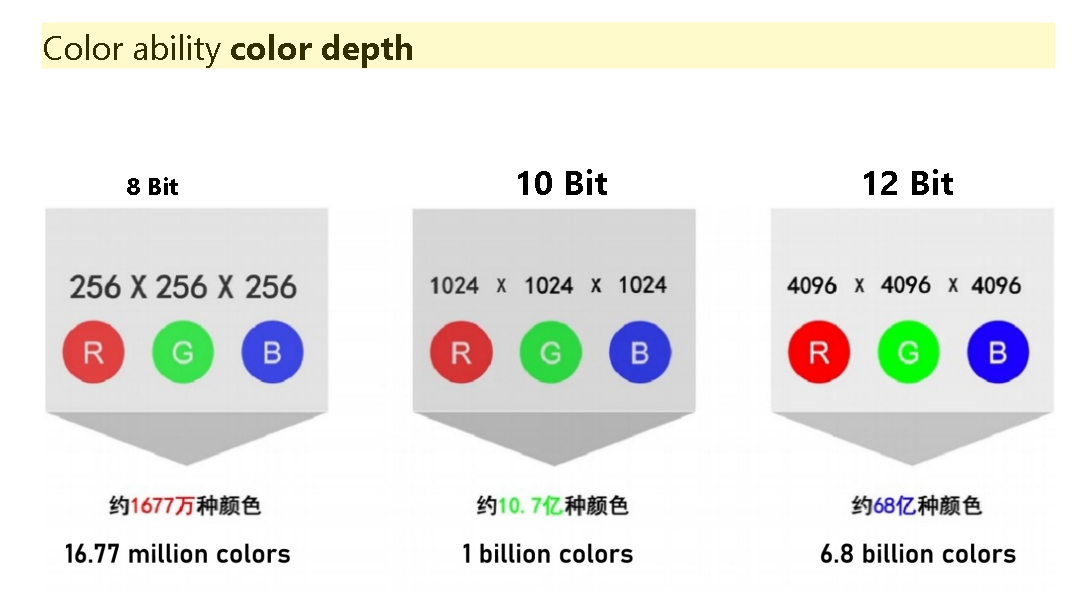
In practical applications, different color depth specifications correspond to distinctly different application scenarios. The most common one is 8-bit color depth, where each of the red, green, and blue color channels is encoded with 8 bits, allowing each channel to display 256 brightness levels (ranging from 0 to 255). Its overall color performance is relatively basic. Due to its small data volume, this specification is usually used in scenarios with low requirements for image quality, such as the signal transmission of standard definition television (SDTV). When the color depth is upgraded to 10-bit color depth, each color channel is encoded with 10 bits, enabling 1,024 brightness levels (from 0 to 1,023). This significantly enhances the smoothness of color transitions. 10-bit color depth can better reproduce high dynamic range images, so it is widely used in high-definition television (HDTV), high-definition video transmission, and LED display systems with resolutions below 4K. 12-bit color depth, on the other hand, is the “standard configuration” in the professional video field. Each color channel encoded with 12 bits can present 4,096 brightness levels (from 0 to 4,095), achieving an extremely high level of color precision. It can perfectly carry the color information of 4K ultra-high-definition videos and 8K ultra-high-definition videos, thus being widely applied in professional video production and high-end display equipment.
Sampling formats, like color depth, also have a significant impact on data volume. Among them, 4:4:4 sampling format, 4:2:2 sampling format, and 4:2:0 sampling format are the three most widely used specifications. They balance image quality and bandwidth requirements by adjusting the sampling rate of different color channels. As the highest-specification sampling format, 4:4:4 sampling format means that each color channel uses the same number of sampling points in both horizontal and vertical directions, and the complete color information of each pixel is accurately captured. This sampling method can maximize the retention of color accuracy and picture details, presenting ultimate image quality. Therefore, it is often used in professional scenarios such as high-quality video transmission, high-resolution LED visualization displays, and digital twins. To meet its huge data transmission needs, optical fiber transmission systems are usually used in such applications.
The 4:2:2 sampling format optimizes bandwidth occupation while ensuring a certain level of image quality. It usually samples color information in the horizontal direction and reduces the number of sampling points in the vertical direction, resulting in different sampling rates for different color channels. This method reduces bandwidth requirements while only slightly sacrificing some color accuracy and picture details, so it is suitable for LED display systems that do not have extreme requirements for clarity. Most of these systems are built using distributed edge decoding systems to adapt to their data transmission characteristics. The 4:2:0 sampling format further compresses the data volume by reducing the sampling of color information in both horizontal and vertical directions. Although it can greatly reduce bandwidth pressure, it also sacrifices more color details. Its common application scenarios include standard definition television (SDTV) and mobile devices with low image quality requirements, which aligns with the priority of bandwidth economy in such scenarios.
It is not difficult to see that the combinations of 8-bit color depth, 10-bit color depth, 12-bit color depth and 4:4:4 sampling format, 4:2:2 sampling format, 4:2:0 sampling format will result in significantly different bandwidth requirements and transmission distance limitations. In the design of video transmission systems, choosing the appropriate specifications of color depth and sampling format is essentially a comprehensive trade-off between image quality, transmission cost, and bandwidth conditions. From standard definition television (SDTV) accessible to ordinary consumers to 8K video production in the professional video field, the technical choices of color depth and sampling have always been the core code that determines the final presentation effect of the picture.
Learn the differences between 8-bit/10-bit/12-bit color depth and 4:4:4/4:2:2/4:2:0 sampling formats, how they impact video transmission quality, bandwidth, and image clarity. Ideal for 4K/8K video production and LED display systems.