







Why LED Display Pixel Pitch Often Comes in Odd Decimals Like P0.9375, P1.25, or P1.875

Ever noticed that LED display pixel pitch often shows up as quirky decimals like P0.9375, P1.25, P1.5625, P1.875, or P3.125, instead of neat round numbers like P3, P1.8, or P0.9? It might seem like a small detail, but in the world of LED screens, this tiny number is actually a big deal.
What Is Pixel Pitch?
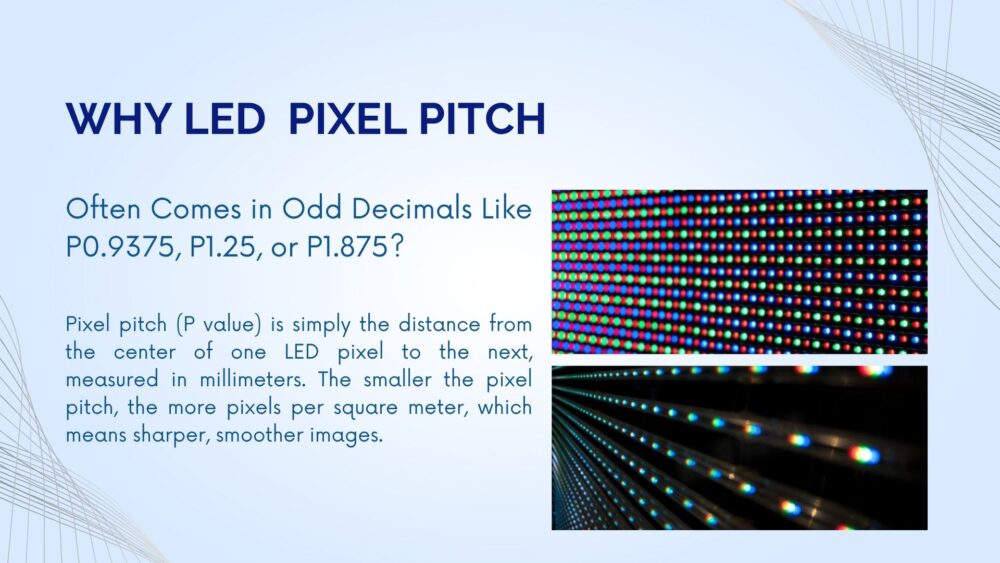
Pixel pitch (P value) is simply the distance from the center of one LED pixel to the next, measured in millimeters. The smaller the pixel pitch, the more pixels per square meter, which means sharper, smoother images.
But here’s the catch: the pixel pitch isn’t random. It has to match the module size so the pixels fit perfectly in a grid.
The Engineering Behind Odd Decimals
Take a standard 320×160mm module as an example:
-
If the horizontal pixel count is 256, the pixel pitch is 1.25mm (P1.25).
-
For 128 pixels, the pitch is 2.5mm (P2.5).
Other common module sizes and their typical pixel pitches include:
| Module Size (mm) | Pixel Count | Pixel Pitch (mm) |
|---|---|---|
| 320×160 | 256 | 1.25 (P1.25) |
| 240×120 | 128 | 1.875 (P1.875) |
| 300×168.75 | 96 | 1.7578 (P1.7578) |
| 500×250 | 160 | 3.125 (P3.125) |
| 250×250 | 160 | 1.5625 (P1.5625) |
| 400×300 (outdoor) | 128 | 3.125 (P3.125) |
These seemingly odd decimals are actually carefully calculated so that pixels line up perfectly across the module, ensuring smooth, seamless images when multiple modules are combined into a larger LED screen.
Why Not Use Round Numbers?
Using round numbers like P3 or P1.8 often causes problems:
-
The pixels won’t divide evenly across the module.
-
Modules may not align properly when assembled.
-
Calibration becomes trickier, and the final image may show gaps or lines.
So, those odd decimals aren’t mistakes—they’re engineered solutions to keep fine pitch LED displays looking flawless.
Conclusion
Next time you see a P1.875 or P3.125 LED screen, you’ll know there’s engineering logic behind it. Odd decimals in pixel pitch ensure that LED modules fit together neatly, maintain sharp visuals, and make installation easier.
Understanding LED display pixel pitch might seem like a small detail, but it’s a key factor for anyone designing or choosing high-resolution indoor or outdoor LED screens.
Have you thought about this question?
Please contact us or leave comments here to discuss!
info@ocolour.com